Three-card tarot reading: Should I accept a job offer that pays less but feels more meaningful?
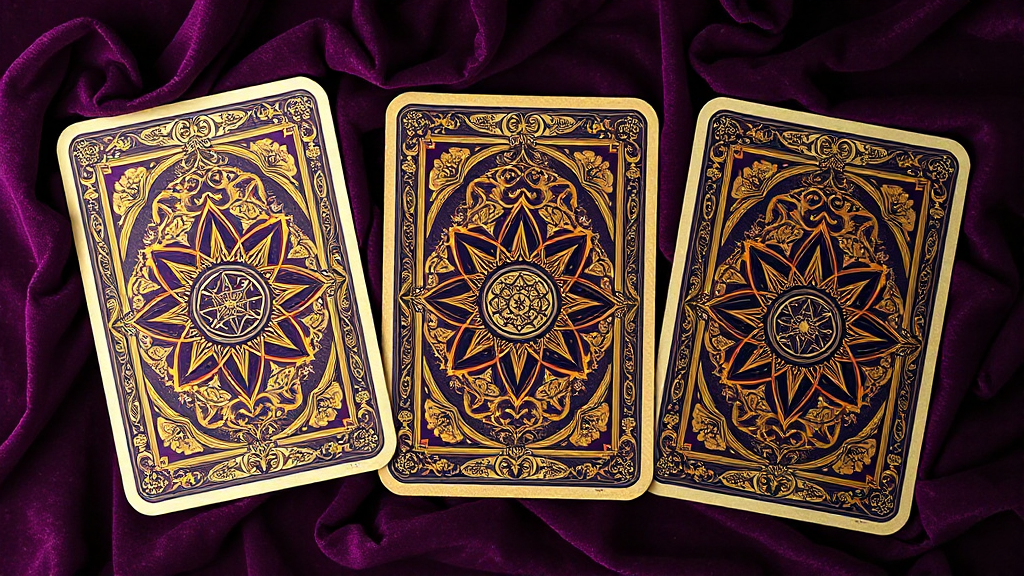
Should I accept a job offer that pays less but feels more meaningful? It is one of the genuinely difficult questions in modern professional life — not because the answer is unclear in principle, but because the practical cost of choosing meaning is concrete and immediate while the cost of choosing money is diffuse and deferred. The three-card spread for this reading drew The Hierophant in the Past, The Tower in the Present, and The Fool in the Future. Read in the Rider-Waite-Smith tradition, this is an unusually direct sequence: institutional structure that was once stabilizing has reached a breaking point, and what comes next requires walking out into uncertainty rather than negotiating a smaller version of the old arrangement.
The Hierophant in the Past position is the most easily-misread card in this spread. Modern readers often see his vestments and conclude that the card stands for religion, but Thoth and Marseille traditions are firmer: The Hierophant is the card of institutional teaching, the way a particular field passes on its standards from one generation to the next. In the Past position, he describes the career structure you grew up in — the path your industry expects, the milestones that mark progress, the unwritten rules about what kind of person succeeds. This is not an indictment. The Hierophant has taught you real things. The reason he is in the Past position rather than the Present is that the lessons he had to teach have largely been received. You have a sense of what good work looks like in your field, what the senior people respect, what gets rewarded. That sense is the inheritance.
The Tower in the Present is where the spread becomes urgent. Pollack describes The Tower as the card of sudden revelation that destroys a false structure, and emphasizes that the structure being destroyed is almost always one the dreamer was actively maintaining. The Tower never appears for someone whose situation is genuinely stable. It appears when an internal contradiction has reached the point where it cannot be paid for any longer. The job offer that triggered this question is the lightning. The lightning did not create the crack in the building. The crack was there. What the offer revealed is that you have been quietly funding a way of working that no longer matches what you actually believe matters. The question "can I afford to take this offer" is the wrong question. The question The Tower poses is: how much longer can you afford to keep the offer you are quietly turning down every Monday morning?
The Fool in the Future is the card that most readers misunderstand by treating it as innocent. Rider-Waite-Smith's Fool is not naive. He is wearing extraordinarily fine clothes and carries a rose and a small bag of provisions. Marseille's reading is sharper: the Fool walks confidently into a future he cannot fully see precisely because he has nothing left to defend. In the Future position, the card is not promising that everything will be wonderful. It is describing the specific quality of energy that becomes available once you stop trying to make the old structure work — a kind of seriousness about new beginnings that is qualitatively different from the cautious incrementalism you have been operating with. The Fool's lightness is earned, not naive. He travels light because the heavy things were not actually load-bearing.
Reading the sequence together, the cards are not telling you what choice to make. They are telling you that the choice has already been made internally, and the only remaining question is how long you will spend rationalizing the lag between knowing and acting. The Hierophant gave you the standards. The Tower is showing you that the structure built on those standards has stopped working for the actual person you have become. The Fool is the energy that becomes available the moment you stop trying to negotiate a hybrid solution that preserves the old building.

There is one specific warning embedded in this spread that deserves to be taken seriously. The Tower never appears in a reading for someone whose finances are in chaos — it appears for someone whose finances are functional enough that the question "can I afford to take a pay cut" is genuinely answerable. The honest version of that question, the version that the cards are asking you to face, is not whether you can survive on less. It is what specifically you have been spending the higher salary on that has functioned as compensation for the work itself. There is almost always something — a particular kind of vacation, a status purchase, a school for the children, a relationship to scarcity inherited from a parent. Until you name what the money was doing for you emotionally, the calculation about whether you can take less stays abstract. Once you name it, the calculation becomes concrete in a way that makes the decision easier to live with.
A practical observation that Pollack returns to about Tower-Present readings: the longer you wait, the larger the eventual disruption tends to be. The Tower does not patiently re-present itself in subsequent months as a slightly less dramatic invitation. It comes back as a worse job, a health event, a relationship breakdown, or a quiet internal collapse that makes you less effective at the high-paying work too. The cost of choosing the meaningful job now is the cost you can see. The cost of waiting is the cost you cannot. The cards are remarkably consistent across traditions on this point: when The Tower is in the Present position and The Fool is in the Future position, the question is not whether you will leave. It is whether you will leave at a time you choose or at a time you do not.
If the offer is still open: take it. The Hierophant has finished teaching you what he had to teach. The Tower is the only honest description of where you are now. The Fool is what becomes available the moment you stop pretending the new job is the risk and the old job is the safety. Reverse those labels in your mind, and the math you have been struggling with becomes legible.
Based on these sources
-
Crowley/Thoth Tarot
Aleister Crowley + Lady Frieda Harris (1944) — esoteric/occult system with deeper symbolism and Kabbalistic correspondences.
-
Spread position
The structural meaning of where a card falls in a spread (Past, Present, Future, Challenge, etc.) — applies to every reading.
-
Rachel Pollack — Seventy-Eight Degrees of Wisdom
1980 — modern psychological and feminist re-interpretation of tarot, widely cited in contemporary readings.
-
Rider-Waite-Smith Tarot
Arthur Edward Waite + Pamela Colman Smith (1909) — the most widely-used modern tarot deck and interpretive baseline.